

A simple question: the last time you typed something into Google, what exactly did you write? It was probably something like this: “How do I get noticed in international markets without a massive budget?”
That is not a keyword. That is a problem.
And Google in 2026 understands exactly that. The days of mechanical keyword matching are over. Today’s search engines interpret the real intent behind every query through sophisticated layers of artificial intelligence. This shift is the biggest paradigm break in the history of SEO — and most businesses still haven’t caught on.
Let’s be honest. A large number of brands are still following the old playbook: a list of high-volume keywords, mass content production, and hope that the algorithm will eventually show some mercy.
But this model has a fundamental flaw: today’s user isn’t looking for a word — they’re looking for a solution.
When someone types “best project management tool for remote teams”, they don’t want a page full of definitions and generic descriptions. They want to know which tool, for their specific situation, is the right choice. That is a cognitive need, not a lexical search.
Traditional SEO doesn’t see this distinction. Semantic SEO starts from exactly this point.
Semantic SEO, in its simplest definition, means this: instead of optimizing for words, optimize for concepts and the relationships between them.
But in practice, it goes much deeper.
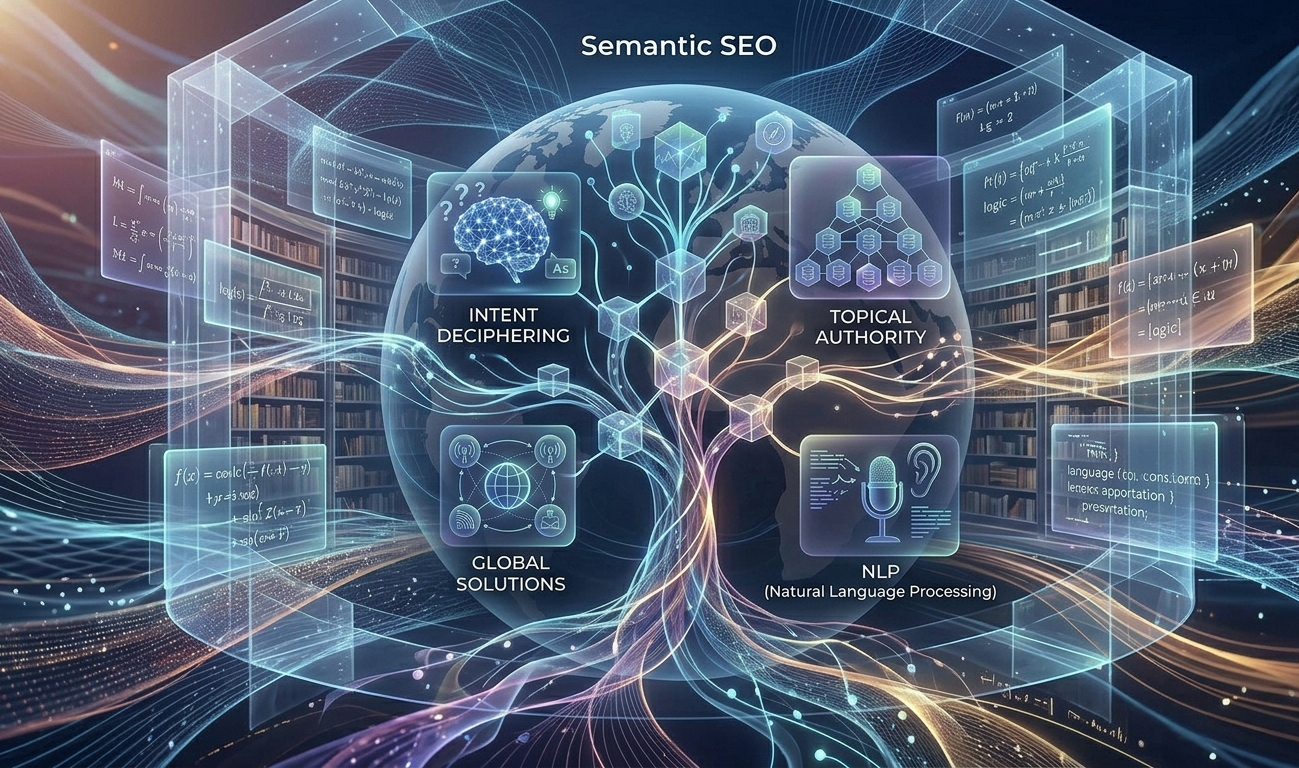
In a semantic approach, your content is no longer a standalone page. It becomes part of a coherent knowledge network — similar to neurons in the brain, each carrying limited meaning on their own, but together forming an intelligent ecosystem. At Atra, we call this approach “human-centered semantic architecture” — a framework where every piece of content plays a defined role in building your brand’s topical authority.
This architecture rests on three pillars:
1. Topical Map Before producing any content, you need to understand what the semantic ecosystem of your niche actually looks like. Which questions are central? Which concepts connect to each other? Which content gaps have your competitors not yet filled?
2. Topical Authority Google places greater trust in websites that cover a subject deeply and comprehensively. That means the ultimate goal is to become the primary reference in your area of expertise — not just to rank for a handful of keywords.
3. Semantic Markup Using Schema Markup and appropriate data structures helps search engines understand the relationships between the concepts on your site more precisely. It’s a technical tool — but one with a direct impact on how your content is semantically understood.
Imagine you’re a SaaS startup trying to get visibility in international markets. Your competitors have years of history, thousands of backlinks, and content budgets that likely exceed your entire operating budget.
Competing head-to-head with them on high-volume keywords? That’s a game you’ve already lost before it starts.
But semantic SEO opens a smarter path: focus on depth, not volume.
Instead of trying to rank for “project management software” — a term with thousands of powerful competitors — you can build a coherent knowledge graph around the specific problems your target audience faces. The result: you become the authority on questions your competitors haven’t answered yet.
The outcome? Traffic that isn’t just higher in volume, but higher in quality. Visitors who are looking for exactly the solution you provide.
Here’s a critical point that’s often overlooked: with the rise of AI-powered search — from Google AI Overviews to Perplexity and ChatGPT Search — your content is no longer written for humans alone. Language models also need to be able to read it, understand it, and select it as a credible source.
This means semantic SEO is no longer just a competitive strategy. It is a survival necessity in the digital ecosystem of 2026. Content with weak semantic structure won’t appear in Google’s search results — and it won’t appear in AI-generated answers to users either. That means becoming invisible across the largest content discovery channels in existence.
If you’re just beginning to integrate a semantic approach into your content strategy, take these three first steps seriously:
SEO in 2026 is no longer a purely technical game. It’s a semantic game — and the winner is whoever best understands what their audience is truly looking for, not just what they type.
At Atra, we see this shift not as a challenge, but as an opportunity. An opportunity for brands ready to move beyond outdated models and establish their place in the new digital ecosystem with depth, credibility, and originality.
If you want to know what the semantic architecture of your brand could look like — we’re here.
This article was prepared by the Atra content team, specialists in smart digital marketing and semantic SEO